
My leadership brand

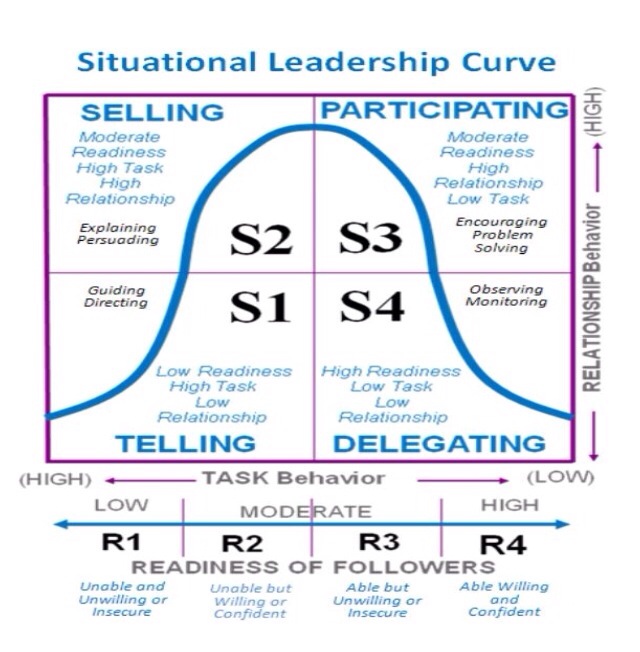
There is a leadership theory called readiness of the followers or group (Hersey, Blanchard 1993) which supports my leadership brand in recently projects .This theory advocates dividing followers into four categories and giving different leadership styles according to their abilities and willingness to work .
These four type of followers, very coincidentally I met all of them: strong ability and willingness, ability but not willing to contribute, willing to contribute but unable, neither willing nor ability. Which is also called R4, R3, R2,R1 (Mullins 2016)

For the first type of follower (R4), I’m not cooperative with her well. When a team member has a strong enthusiasm to put forward and want to realize an idea of her own, which I think needs more carefully feasibility study , and to evaluate the degree of adaptation to the task. That is easy to undermine the enthusiasm of the team member who felt that I was limiting and controlling her, although my goal is just to make her idea more suitable for our theme. After several times of cooperation, it was found that encouraging, supporting or guiding those type followers might be more appropriate.
For the second followers (R3), their own ability is good, but relatively lazy, not very active to attribute. For this kind of people, I think we could ask her opinions more actively. According to their ideas, to give direct feedback and ask them to continue to expand their ideas in the right direction. They were often willing to contribute in this passive mode.
For the third kind of followers (R2), they are willing to work but their ability is not enough. I must be patient and clear in explaining the goal of the task, and give her some ways to achieve it, teach her how to think, how to solve problems, and then follow up on her project completion and give timely feedback.
For the fourth kind of players (R1), honestly speaking, I really don’t like to cooperate with this kind of group members, but if I have to cooperate with them, I think the best way is to break down the tasks into simple tasks, and let them implement it. Tell them directly how to modify it, rather than giving them suggestions and waiting for figuring it out by themself.
The relevance of my leadership brand to fashion industry
I think this conditional leadership style according to members is very suitable for the fashion industry I will be engaged in the future. There are three reasons.

Firstly, the fashion industry is internationalized. I will meet people from different countries and cultures in this industry. Their working habits, working methods and working thinking modes are inevitably different.
Secondly, the fashion industry has a fast-paced and high-pressure environment, including many working steps, and each of them could not be wrong. In this environment, a leader must make the most correct decision quickly, so how to effectively lead employees with different abilities is worth thinking about, then I think readiness theory is the most flexible and effective.
Thirdly, this kind of leadership style requires leaders to have the ability and willingness to grasp employees quickly, and to be able to change their working methods, which is not suitable for everyone. After self-analysis and practice, it is found that this theory and method is most suitable for me, and could solve problems and bring good results.
Feed back from 3 people came from different teams

The first people regards me as a tutor, In each of working step, such as understanding the task, analyzing the task, how to fix it, and finally coming up the result, she would willing come to ask my opinions.
The second team member felt that I was very suitable for building a framework. When I finished the whole framework of ppt, she just needed to complete and enrich the content under this framework, which made her feel very useful and efficient.
The third follower felt uncomfortable of my leadership style because she thought that I spend too much time to thinking, worried too much, and always delayed making decisions or questioned her actions.
My current strengths and development needs
Through the feedback from these team members, I summed up my strengths: strong analytical understanding, ability to deal with complex things, good at building frameworks, and good at visualizing their own views, could guide others to grow. However, I also need to strengthen my judgment, action, motivation and support for my team members.
My future development plan

- Continue to maintain my strengths, my strengths can bring logical integrity to the team’s results, and have a good visual expression. So we have to keep and be more sophisticated about my strengths.
- Improve my judgment and action. Because I rely too much on my ability to analyze and organize, I am lagging behind in drawing conclusions and motivation. In the future, I could trust my intuition more, not think too much, and try to act faster as much as possible.
- Encourage and support teammates. For those who are unwilling to participate in team work, motivating and supporting them is sometimes a waste of energy and time under time pressure, but I could actively encourage teammates who have their own ideas, but are not willing to share them; and to support and guide members who are very thoughtful and motivated.
Reference list
Conversation, T. (2019). Can the Fashion Industry Ever Really Be Sustainable?. [online] The Fashion Law. Available at: http://www.thefashionlaw.com/home/can-the-fashion-industry-ever-really-be-sustainable [Accessed 12 Apr. 2019].
Drypen.in. (2019). Hersey-Blanchard Situational Leadership Theory | drypen.in. [online] Available at: http://www.drypen.in/human-resource/hersey-blanchard-situational-leadership-theory.html [Accessed 12 Apr. 2019].
Hersey, P. and Blanchard, K. H.(1993) Management of Organizational Behavior: Utilizing Human Resources, sixth edition, Prentice Hall
Laurie J. Mullins (2016) Management & Organizational Behavior, Eleventh edition, Pearson Education
Mep.purdue.edu. (2019). Situational Leadership: A Guide to Coaching Employee Performance | Manufacturing Extension Partnership. [online] Available at: https://mep.purdue.edu/news-folder/situational-leadership-a-guide-to-coaching-employee-performance/ [Accessed 12 Apr. 2019].
Nandanbuildcon.com. (2019). Future Plans. [online] Available at: http://www.nandanbuildcon.com/future-plans [Accessed 12 Apr. 2019].
Schrage, M. (2016) ‘Like It or Not, You Are Always Leading by Example’ Harvard Business Review [online] October 05, 2016. Available from < https://hbr.org/2016/10/like-it-or-not-you-are-always-leading-by-example> [04 August 2017]
Zenger Folkman. (2019). Ep. 62: Giving Feedback to Millennials – Zenger Folkman. [online] Available at: http://zengerfolkman.com/podcast-ep-62-giving-feedback-to-millennials/ [Accessed 12 Apr. 2019].
 Fiona's blog
since we have done the project, I think you are a good manager in our team work.
LikeLike
Thank you very much!!
LikeLike
I have cooperated with you, so I know you must be an excellent leader. I wish you better and better in future development!
LikeLike
I hope you can lead a successful fashion brand in the future.
LikeLike
Awesome!
LikeLike
It’s clear and trageted.I was pleasantly surprised to find that you have such an excellent leadership skills.
LikeLike